PUBLISHED ARTICLE / XUNPAN
Custom Wire Harness RFQ Checklist: From “Quote From a Photo” to a Verifiable Build
A custom harness is rarely just “a cable.” The interfaces, branches, and change requirements need to be stated together. This checklist helps buyers prepare an RFQ that can be reviewed against shared information.
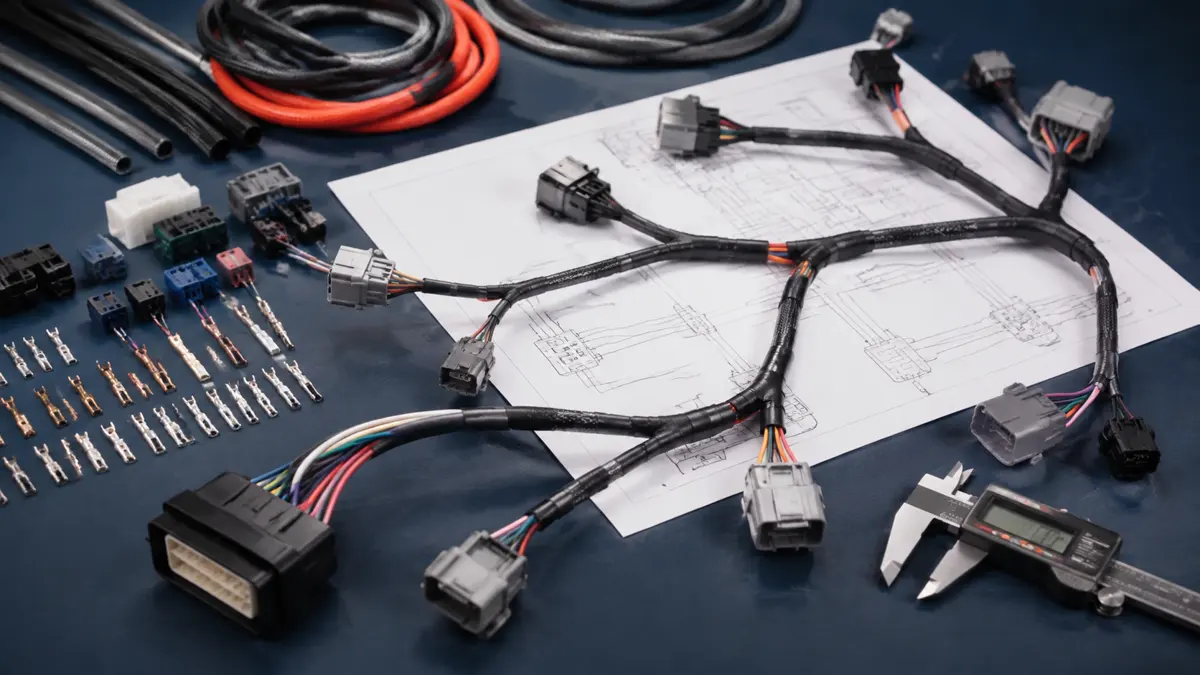
“Please make a wire harness like this photo” is a common RFQ opening, but it is seldom enough technical input. A distant photo may show an approximate route while saying nothing reliable about connector part numbers, cavity assignments, branch lengths, terminal construction, protection, label positions, or permitted tolerances. When the information is missing, a supplier has to guess. Even a visually similar sample can later fail to mate, reach its connection point, follow the intended branch direction, or match the interface definition.
The aim is not to freeze every detail in the first email. It is to give purchasing, engineering, and quality teams one traceable set of information to review. The checklist below turns “quote from a photo” into “review against defined inputs.”
Start with a BOM, but not just component names
A bill of materials is the frame of a harness RFQ. Each item should preferably have a unique reference, component name, quantity, revision or part number, and position in the assembly. For connectors and terminals, “2-pin plug” or “red and black wire” is usually insufficient. Housing family, terminal type, circuit count, keying, latch, seals, and companion parts may all differ.
Where a customer-specified brand part number or an approved-substitution rule exists, identify it clearly. If selection is still open, mark it as pending and identify the party responsible for confirming it. Do not present unknown information as a settled specification. That distinction helps a supplier separate fixed quotation inputs from points that need technical clarification.
A pinout matters more than wire colour
Wire colour helps identification in the field; it is not a complete electrical definition. Each connector should have a cavity view and a pin-to-pin relationship: viewing direction, numbering orientation, what each position connects to, and whether there are empty cavities, jumpers, shields, grounds, or termination requirements. If several connectors look alike, assign each a unique identifier.
Even a simple wire list reduces ambiguity: source connector and cavity, destination connector and cavity, wire ID, colour, gauge, length, and whether heat-shrink or sleeving is required. For a branched harness, give a dimension reference from the breakout to each end. Do not provide only an overall length.
State lengths, datums, and tolerances together
“Length 500 mm” can mean several things: conductor length, exposed jacket length, terminal-to-terminal distance, or the path length through an assembly. A drawing should identify measurement start, end, and route, then state the dimensional datum for each branch. If a harness has to pass around structure or fit a restricted space, supplement two-dimensional dimensions with the installed position, tie locations, exit direction, and minimum bend-space constraints.
Tolerances need the same discipline. Not every dimension needs a tight tolerance, but the document should distinguish dimensions that control assembly from those that simply support appearance or bundling. That avoids turning non-critical dimensions into unnecessary production restrictions while missing the dimensions that govern connector position.
Drawings, samples, and photographs have different jobs
A controlled drawing is best for defining structure and revision. A physical sample can support checks of feel, assembly, and existing parts. Photographs can add real-world routing and space context. A useful package often combines a revision-controlled assembly drawing, front and rear connector photographs, a wire list, and, when available, a reference sample.
If the sample and drawing differ, state which one governs the current build. Do not leave the supplier to decide whether to follow the sample or drawing. Record the sample’s role as well: for appearance reference only, for termination reference, or as a pending functional baseline. That does not make an unverified promise about test results or production consistency.
Put tests and change control on the review list
A project may require continuity, insulation, pull, dimensional, or assembly checks. The method, acceptance criteria, sampling approach, and report format should be defined by the project documentation or responsible party. Without a stated requirement, do not treat a particular test, pass result, or certification scope as an established fact.
Harnesses can also change through connectors, wire length, labels, or packaging. At RFQ stage, identify drawing revision, effective date, change-submission route, and who can approve substitutions. When engineering updates arrive, that makes it possible to trace the impact instead of comparing two similar-looking photos.
A practical custom-harness RFQ checklist
- Project name, assembly part number, drawing revision, and intended use;
- BOM covering connectors, terminals, wire, protection, sleeving, ties, and labels;
- Each connector’s part number, cavity view, keying, mating terminals, and sealing requirements;
- A complete pin-to-pin wire list, including colour, gauge, core count, and shielding/grounding requirements;
- Overall and branch lengths, datums, tolerances, exit directions, and installation constraints;
- The priority and permitted use of samples, photographs, and drawings;
- Tests, documents, packaging, labels, and delivery requirements to be reviewed;
- Drawing revision, substitution limits, change notification, and approval method.
HSC’s current catalogue includes Internal Wiring Harness, Internal High Temp Wiring Harness, and Ribbon Cable directions. Use them as a starting point for a specific application discussion; confirm the final configuration item by item against the model, drawing, destination market, and project information. Browse the Wire Harnesses catalogue, or send the RFQ package through the contact page.
This article provides general industry information. Specific technical requirements remain subject to the current standards and certification-body rules of the target market.
RELATED EVIDENCE