PUBLISHED ARTICLE / XUNPAN
Choosing AWG or mm² for a Power Cord: Do Not Start With Current Alone
AWG and mm² both describe conductor size, but neither number alone answers whether a cord is right for an application. This guide identifies the information buyers should verify together.
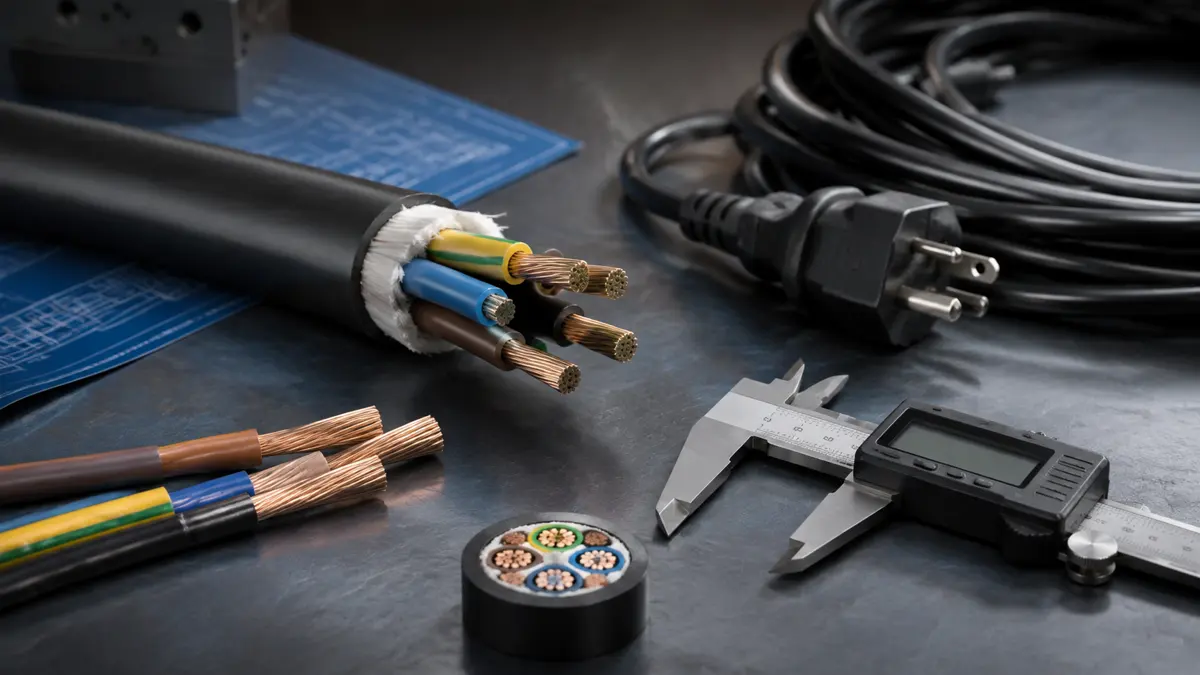
An RFQ that states “16 AWG” or “1.5 mm²” looks specific, yet it does not answer whether the conductor is suitable for the equipment. Choosing a wire gauge from current alone can leave out cord length, ambient temperature, grouped or individual installation, jacket construction, wall plug, appliance end, and destination-market rules. For a finished power cord, those conditions define what must be verified; one AWG or mm² number does not do it alone.
A more useful starting point is to treat AWG and square millimetres as two specification languages. AWG appears frequently in North American documentation, while mm² is common in metric documentation. They can support communication and an initial comparison, but a conversion is not a universal ampacity chart detached from the product conditions.
AWG and mm² both describe conductor size, differently
AWG means American Wire Gauge and identifies a standard sequence of round-conductor sizes. ASTM B258 covers nominal diameters and cross-sectional areas for AWG sizes. Square millimetres directly state conductor cross-sectional area. In either notation, first establish that the value describes the bare conductor area or size, not the outside diameter of the finished cord.
One rule can feel counterintuitive: in the AWG sequence, a smaller gauge number generally denotes a larger conductor, whereas a larger mm² value denotes a larger cross-sectional area. That direction is useful for reading drawings and comparing specifications, but a purchase record should not retain only “16 AWG” or only “1.5 mm².” Also ask the supplier to confirm conductor material, construction (solid or stranded), core count, and the complete designation in the drawing or specification.
Why one table cannot set a universal current rating
Allowable ampacity is not a function of conductor area alone. The applicable electrical code, insulation temperature rating, ambient temperature, heat dissipation, number of adjacent or bundled conductors, installation method, length, and connector rating can all affect the project decision. Requirements addressed in Article 310 of NFPA 70 (NEC) illustrate why the applicable rules and installation conditions matter more than a copied simplified table.
For equipment power cords, add two further checks. First, align the equipment nameplate voltage, frequency, rated current or power with the intended supply circuit. Second, establish whether the plug, connector, jacket, and certification documentation cover the same finished-cord configuration. Two cords marked with the same AWG or mm² can have different lengths, thermal conditions, or terminations and should not be assumed interchangeable.
Length changes voltage-drop and design margin, not just copper use
As a cable becomes longer, voltage drop caused by conductor resistance deserves more attention. When load current, circuit length, or temperature conditions change, a wire-gauge selection that initially appears the same may no longer be appropriate. State finished-cord length and allowable tolerance in the RFQ, and identify whether the cable is used inside equipment, in fixed wiring, with movable equipment, or as an extension cord.
This does not require a buyer to perform every electrical calculation. It prevents a supplier from guessing without the length and use case. Where a project requires a conclusion about voltage drop, temperature rise, or continuous load, the project engineer or the party responsible for the applicable standard should confirm it against the actual conditions.
Put wire gauge into one complete RFQ
A usable RFQ should include at least:
- Destination sales and use market, plus applicable standards or certification requirements;
- Equipment nameplate information: voltage, frequency, rated current, or power;
- Conductor specification: AWG or mm², with material, core count, and construction;
- Finished-cord length, permitted tolerance, expected flexing, and installation method;
- Ambient temperature, heat sources, indoor/outdoor use, and other operating conditions;
- Wall plug, appliance-end interface, jacket, and colour requirements;
- Drawings, labels, test records, or certification documents to be checked.
That turns “16 AWG or 1.5 mm²?” from an isolated question into a traceable project decision. When drawings from different markets use different notation, have the engineering or certification owner confirm the applicable rules before conversion and sample approval. That is usually more efficient than repeatedly changing the cord during quotation.
HSC’s current catalogue includes Power Cord and Electronic Wire product directions; neither record lists a certification mark in the current snapshot. Confirm the final configuration against the specific model and project documentation, and browse the Wire and Cable catalogue for current directions.
This article provides general industry information. Specific technical requirements remain subject to the current standards and certification-body rules of the target market.
RELATED EVIDENCE
Related products and certifications
Related products