PUBLISHED ARTICLE / XUNPAN
NEMA 1-15P, 5-15P, or 6-20P? Start With the Circuit, Not the Plug Photo
NEMA plugs should not be selected by appearance alone. Start with circuit voltage, current, grounding, and the appliance-end connection.
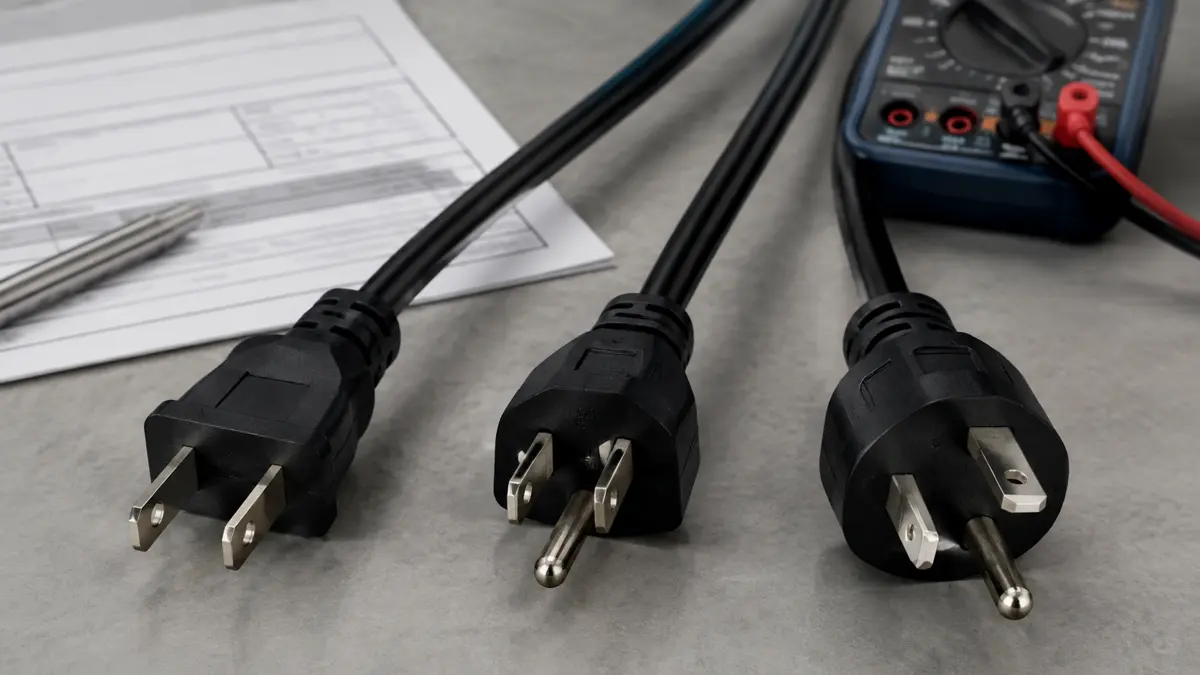
“North American power cord” is not a complete RFQ. Even adding “NEMA plug” leaves room for a costly mismatch among 1-15P, 5-15P, and 6-20P. Some equipment is designed without protective grounding; some requires it. Some connects to a 125 V branch circuit, while other equipment is designed around a 250 V, 20 A configuration. Similar-looking plugs do not make those circuits interchangeable.
A safer selection sequence starts with three questions, not a photograph: What circuit will supply the equipment? Does the equipment require protective grounding? What is the appliance-end connection? Once those answers are fixed, the NEMA configuration becomes useful.
The difference is more than one grounding pin
A NEMA configuration designation identifies a wiring-device family, current rating, and device type. In this context, P means plug; the corresponding receptacle commonly uses R. Using the NEMA WD 6 configuration system, buyers can establish an initial direction:
| Configuration | Nominal circuit rating | Poles / wires | Protective ground | First procurement question |
|---|---|---|---|---|
| NEMA 1-15P | 125 V, 15 A | 2-pole, 2-wire | No | Is the equipment designed without reliance on protective grounding? |
| NEMA 5-15P | 125 V, 15 A | 2-pole, 3-wire | Yes | Is the grounding path complete through the appliance end? |
| NEMA 6-20P | 250 V, 20 A | 2-pole, 3-wire | Yes | Do the nameplate and supply design match a 250 V, 20 A configuration? |
These ratings define the configuration boundary. They do not mean that every finished cord can be used at the limit under every condition. Conductor size, length, temperature rating, appliance connector, certification file, and actual load still have to be reviewed together.
1-15P: ungrounded does not mean “remove the ground”
NEMA 1-15P is a 125 V, 15 A, two-pole, two-wire configuration without a protective-grounding contact. HSC's 1-15P polarized power cord represents this product direction and is marked UL and ETL in the current catalogue snapshot.
Suitability is not determined by wattage alone. The equipment's electric-shock protection design must permit operation without reliance on protective grounding. If the original equipment requires a protective ground, changing a 5-15P to a 1-15P to fit a two-slot receptacle is not an acceptable shortcut, and neither is deleting the grounding conductor. On a polarized version, the different blade widths also preserve an intended line and neutral relationship; drawings, plug construction, and internal wiring need to agree.
5-15P: common does not mean universal
NEMA 5-15P is also a 125 V, 15 A configuration, but it includes a protective-grounding contact. It is the familiar three-prong North American form. The HSC catalogue contains straight, angled, rain-resistant, and appliance-end variants. The 5-15P to C13 power cord referenced here is marked UL and ETL in the current snapshot.
Buyers should separate “the wall end is 5-15P” from “the finished cord is correct.” The grounding conductor must remain continuous from the plug to the equipment grounding point. If the appliance end is IEC C13, the inlet, ratings, temperature category, and cordage construction still need confirmation. A photograph of the wall plug cannot identify the other end or prove that a certification file covers the requested model.
6-20P: verify the 250 V circuit before treating 20 A as an upgrade
NEMA 6-20P is a 250 V, 20 A grounding configuration. Its blade arrangement differs from the 125 V families in part to reduce the chance of connecting devices to the wrong voltage class. OSHA requirements for workplace receptacles reinforce the underlying rule: grounding-type receptacles are to be used only for their rated voltage class and current, and devices serving different voltages, frequencies, or current types are to be noninterchangeable.
The HSC catalogue's 6-20P three-prong power cord is marked UL and ETL in the current snapshot. That does not make it a replacement for 5-15P. First obtain the equipment nameplate and supply design and confirm that the equipment is intended for the relevant 250 V, 20 A circuit. Then verify conductor construction, length, thermal conditions, appliance-end termination, and certification scope.
The wall plug can be right while the appliance end is wrong
A power cord has at least two interfaces. The NEMA designation covers the supply end. The other end might be IEC C13, C5, or C7, stripped conductors, terminals, or a custom connector. An RFQ that specifies only “NEMA 5-15P” does not define a unique cord.
Take the catalogue's 5-15P to C13 product as an example: 5-15P identifies the wall plug and C13 identifies the appliance connector. Even when both names are correct, the buyer still needs to verify:
- That the appliance inlet matches the connector;
- Whether protective grounding is required and continuous;
- Cordage type, conductor count, conductor size, and length;
- Ambient temperature, flexing, indoor or outdoor use, and other project conditions;
- Target-market certification and whether the file covers the specific plug, cordage, connector, and factory combination.
Those details define the finished cord. One NEMA number cannot replace them.
Give the supplier a set of inputs that can be checked
The buyer does not need to perform the entire compliance assessment, but the RFQ should provide enough controlled information. Include at least:
- Destination and use markets;
- Equipment nameplate voltage, frequency, current, or power;
- Equipment grounding class and an appliance-inlet photo, model, or drawing;
- Intended NEMA plug and appliance-end connector;
- Cordage type, conductor count, conductor size, length, and tolerance;
- Indoor or outdoor use, ambient temperature, flexing, and other use conditions;
- UL, ETL, or other compliance records to be verified;
- Sample, drawing, label, and packaging requirements.
If items 2 and 3 are still unresolved, have the appliance engineer or certification owner settle them first. That is usually faster than trying to reverse-engineer the design from a plug photograph.
A practical selection sequence
Choosing among 1-15P, 5-15P, and 6-20P comes down to four steps: establish circuit voltage and current, determine whether protective grounding is required, confirm the appliance-end interface, and then verify the finished cordage and certification file. If any step remains unanswered, appearance alone is not a sound basis for ordering.
Use HSC's UL/ETL American plug catalogue to review current product directions. If your project is still choosing among 1-15P, 5-15P, and 6-20P, send us the equipment nameplate, interface drawing, and destination market so the specific model can be checked.
This article provides general industry information. Specific technical requirements remain subject to the current standards and certification-body rules of the target market.
RELATED EVIDENCE