PUBLISHED ARTICLE / XUNPAN
Public Charging Is Expanding: Why an EV Cable RFQ Must Separate AC, DC and Charging-Gun Cables
Public charging networks continue to expand. “AC cable,” “DC cable” and “charging-gun cable” identify a product direction, but they do not replace interface, environment, construction, document and acceptance requirements.
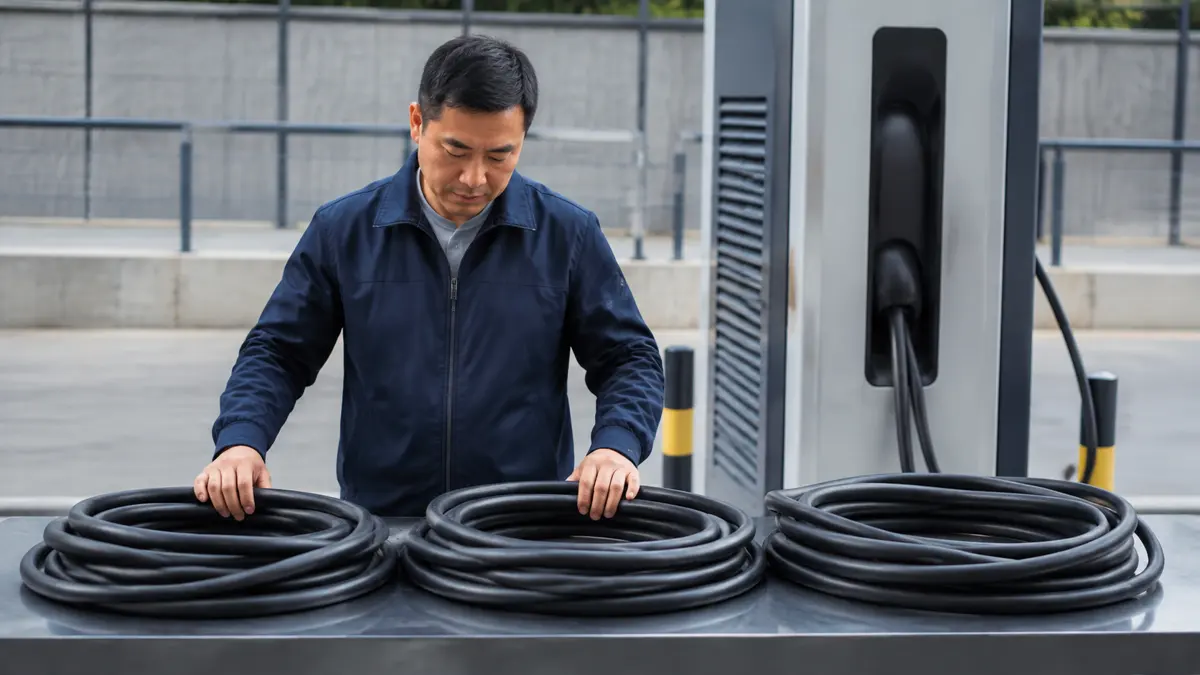
Imagine an RFQ that says only, “Five-metre fast-charging cable required.” The supplier still cannot tell whether the project uses AC charging equipment, DC charging equipment or a charging-gun cable involving a hand-held interface. The destination market, two endpoints, fixed or removable installation, indoor or outdoor conditions, and the equipment definition behind “fast charging” are all unknown.
That ambiguity becomes more costly as the market expands. The International Energy Agency’s Global EV Outlook 2026 reports that nearly 1.8 million public charging points were added worldwide in 2025, an increase of more than 33% from the previous year, bringing the total stock above 7 million. The same analysis shows about 1 million public ultra-fast charging points in 2025 and says the average rated power of public charging points rose by about 15% year on year.
These figures show that charging networks are expanding and power tiers are changing. They do not determine the construction of an individual cable. For procurement, the first step is not to add “fast charging” to the title. It is to define AC or DC, the complete supply boundary and the destination market.
What do the three names actually establish?
HSC’s current catalogue includes a New Energy AC Charging Cable, a New Energy DC Charging Cable and an EV Charging Gun Cable. These names direct the discussion toward different product families, but none is a complete specification.
| RFQ term | Useful starting point | Project inputs still required |
|---|---|---|
| AC charging cable | The discussion concerns cable for an AC charging path | Destination market, equipment architecture, both interfaces, electrical inputs, cable construction, installation environment and documents |
| DC charging cable | The discussion concerns cable for a DC charging path | Charger output, vehicle interface, assembly boundary, temperature conditions, signal or auxiliary circuits, and any project-specified cooling architecture |
| Charging-gun cable | The project concerns a product direction involving a hand-held charging interface | Included components, connector-and-cable combination, length, retention and operation, environment and acceptance scope |
The table deliberately omits ratings and connector names because those must come from the specific project. In a US context, the US Department of Energy’s Alternative Fuels Data Center describes AC Level 1, AC Level 2 and DC Fast Charging separately. US voltages, interfaces and level terminology should not be copied into another market without checking that market’s requirements.
Define the connection boundary before the cable
Before requesting a quote, show the two endpoints: inside the charging equipment, at the charger output, across a removable cable, at a hand-held interface, or at the vehicle inlet. State whether the purchase is for bulk cable, a terminated cable, a cable with an interface component, or a more complete assembly.
An unclear boundary changes both parties’ understanding of the bill of materials, dimensions, testing and price. “Charging-gun cable” may be used by one buyer for cable alone and by another for an interface-and-cable combination. An industry shorthand should not carry the contractual specification. Add a supply-boundary drawing to the RFQ and mark every included and excluded component.
If the project has an equipment drawing or sample, provide its revision. Photographs are useful for orientation, but they do not replace dimensional drawings, mating-interface information and engineering-approved inputs.
After AC or DC, answer “for which equipment?”
The IEA groups public charging points by power to analyse infrastructure trends. Its 150 kW statistical threshold for ultra-fast charging is not a cable specification. Electrical requirements for the cable and assembly must come from the charger and vehicle-platform design: system voltage, current, continuous and peak conditions, protection strategy, control or signal needs, and the engineering margin adopted by the project.
Two DC charging projects may differ in equipment power, environment, interface, cable length and thermal management. If the system uses temperature monitoring, communication or auxiliary conductors, identify each in the interface definition and cable construction. If the project specifies liquid cooling or another cooling architecture, provide the circuit, medium, connection boundary and acceptance requirements. The words “ultra-fast” do not prove that a particular cooling structure is required or already included.
An AC project also needs more than “AC cable.” State whether the cable is tethered to the equipment or removable, how it connects at the equipment and vehicle ends, where it will be used, and which equipment and interface rules apply in the destination market.
Replace the word “outdoor” with real exposure
Public chargers may be installed in car parks, highway service areas or commercial properties, but their exposure differs widely. Convert “outdoor” into reviewable inputs: temperature range, sunlight, rain or cleaning-water source, dust, potential standing water, chemicals, dragging, bending, vehicle and pedestrian activity, and whether the connection is mated during operation and service.
If an IP classification is required, identify the exact item and state: an interface enclosure, a correctly mated connection, the charging-equipment enclosure or another component. A statement for one component or mating state should not be extended automatically to the entire cable and charging system.
Length is more than a quotation field. It affects storage, contact with the ground, reach to the vehicle inlet and site management. Give the usable length, allowance inside the equipment, permitted tolerance, storage method and minimum operating space so that sample approval reflects the installation.
The destination market defines interfaces and documents
A “universal EV charging cable” is not a globally acceptance-ready specification. The buyer should identify the installation country or region, equipment use, charger platform and vehicle-interface requirement before listing applicable standards, certifications, customer specifications and charging-network requirements.
There is another important boundary: the current HSC catalogue records for the three products cited in this article all have empty certification arrays. This does not prove that a product can never support a project, and it must not be rewritten as an existing certification claim. It means the RFQ and article must remain transparent. For the proposed model, the supplier needs to confirm the drawings, samples, test basis, certifications or project documents it can provide; the buyer cannot infer compliance from the product name.
Document review must also follow the complete combination. Cable documents, interface-component documents and project records for the finished assembly may cover different scopes. Ask which model, construction, material, production location and revision each document covers, and keep unresolved items visible in the review list.
Sample approval is more than “it plugs in”
Once a sample is available, project-specific review should include at least:
- whether both interfaces and the supply boundary match the approved drawing;
- usable length, outside diameter, color, marking, termination direction and agreed dimensions;
- unreasonable pull or bending during charger installation, storage, ground handling and vehicle connection;
- access and handling of the hand-held section within the expected operating space;
- alignment of control, signal, temperature-monitoring or auxiliary circuits with the interface definition, where applicable;
- whether material, construction, test and certification documents correspond to the proposed complete model; and
- clear sample revision, change record and production traceability.
One successful insertion shows a single geometric fit. It does not establish electrical, environmental, durability, documentation or destination-market compliance. The responsible engineer should define acceptance for the actual application.
Nine inputs to put in the RFQ
- Destination and use case: country or region and home, public, fleet or other application.
- Charging path: AC or DC and the relevant charging-equipment architecture.
- Complete supply boundary: bulk cable, terminated cable, charging-gun cable or another assembly, with included components.
- Both interfaces: charger and vehicle endpoints, designated mating parts and drawing revisions.
- Electrical and auxiliary circuits: voltage, current, duty, protection, communication, signals and temperature monitoring.
- Environmental and mechanical conditions: temperature, water, dust, sunlight, chemicals, dragging, bending, storage and installation space.
- Cable and appearance: conductor and jacket requirements, length, tolerance, color, marking and termination direction.
- Standards and documents: destination-market, customer and operator requirements, with records for the proposed complete model.
- Sample and production acceptance: inspection method, approved sample, change control and traceability.
Growth in public charging will create more projects, but it will not collapse them into one standard “fast-charging cable.” Buyers can review HSC’s wire and cable catalogue and wire harness catalogue, then send HSC these nine project inputs for proposed-model assessment. Once the system boundary is explicit, quotation and sample review can use the same baseline.
This article provides general industry information. Specific technical requirements remain subject to the current standards and certification-body rules of the target market.
RELATED EVIDENCE