PUBLISHED ARTICLE / XUNPAN
BSMI Rubber Power Cord Set RFQ: 7 Points to Confirm Before Quoting
An RFQ that says “BSMI rubber power cord set” usually still lacks the information that makes a quote comparable and buildable. This guide identifies seven items purchasing and engineering teams can confirm first.
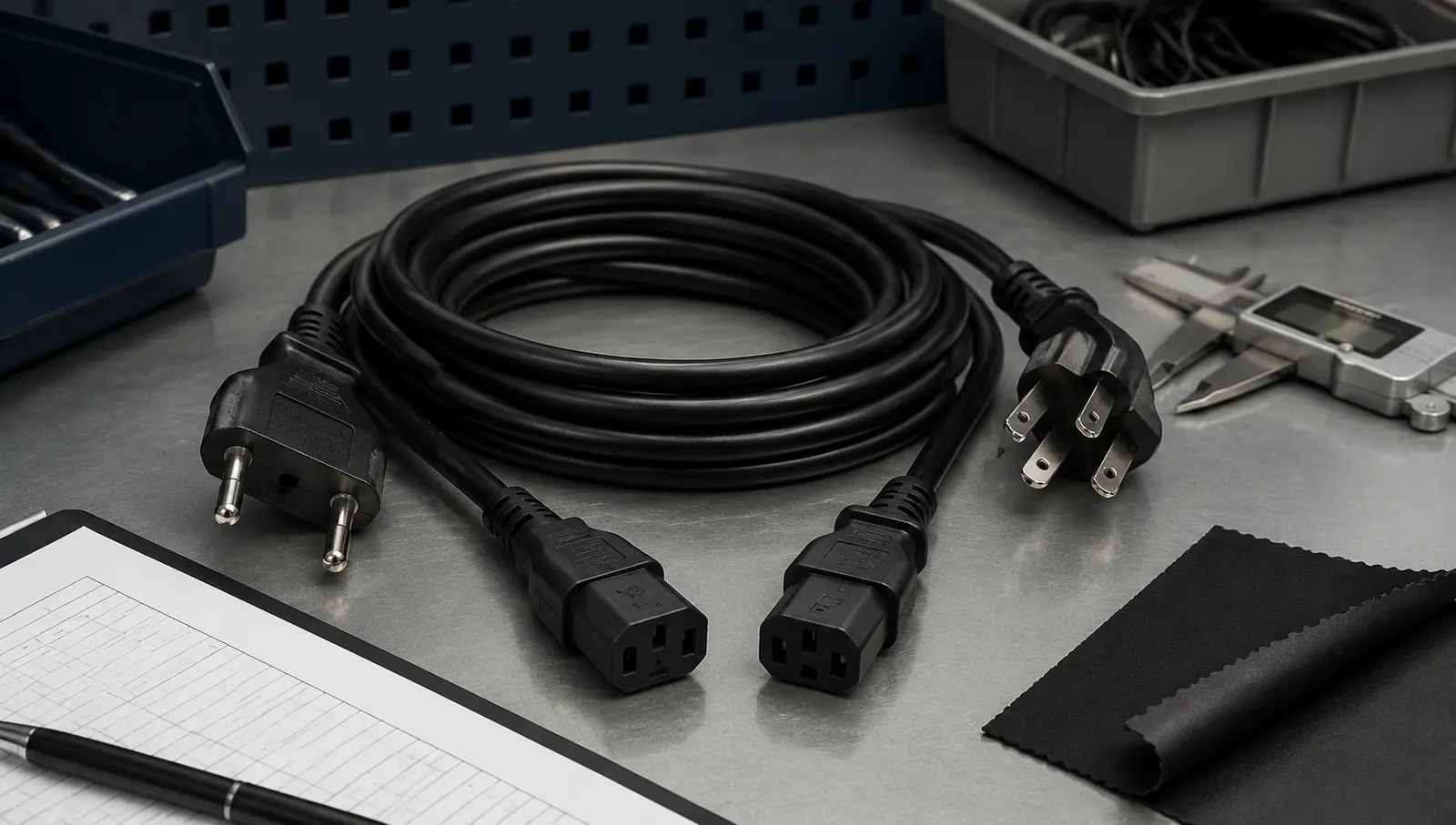
“We need a BSMI rubber power cord set for Taiwan.” That opening identifies a destination market and a material direction, but it is not yet enough for a supplier to quote a comparable, workable assembly. Two power cords that look similar can differ in wall plug, appliance-end connector, ratings, length, jacket construction, and the scope of supporting documentation. If those details only emerge after quotation, samples and lead times can end up being revised repeatedly.
A more useful approach is to turn “BSMI,” “rubber,” and “power cord set” into items that can be checked one by one. The seven points below do not replace the applicable standards or a certification body’s determination. They give purchasing, engineering, and the supplier one shared set of inputs to review.
1. Define the wall plug before saying only “Taiwan type”
State whether the requirement is for a two-pin, three-prong, or another specific construction, and include clear photographs, a drawing, or an existing part number. Include grounding, polarity, dimensions, cord exit direction, or colour requirements where they matter. “Taiwan plug” on its own can lead each side to assume a familiar shape, only to find later that it does not match the equipment or packaging.
HSC’s current catalogue includes Taiwan Two Pin Power Cord, Taiwan Three Prong Power Cord, and Taiwan Three Prong 20A Power Cord directions. Each respective product record lists BSMI. Use them to begin the interface discussion, then confirm the final configuration against the specific model and project documents.
2. Describe the appliance-end interface completely
A power cord set is more than its wall plug. The appliance end may be a C5, C7, or C13-style connector, a custom termination, stripped wire, terminals, or another connection method. Provide front and rear interface photos, dimensions, pin details, or the mating-equipment model. If there is an existing sample, state whether it is for appearance, interface reference, or the current governing basis.
Without appliance-end information, a supplier can only quote an incomplete combination. A correct wall plug still leaves the finished cord unusable if the equipment end does not mate.
3. Put voltage, current, and equipment nameplate details in the same RFQ
Provide the equipment nameplate voltage, frequency, rated current or power, together with the intended use of the cord set. Do not give only a verbal ampere figure and leave the supplier to infer the equipment conditions. The plug, connector, conductor, jacket, and documentation for a finished assembly need to be checked as one combination against the project information.
Where the project already has applicable standards, test requirements, or customer-specified documents, attach them to the RFQ. Requirements that are not settled can be marked as pending, but a certificate or test result should not be assumed to cover every variation.
4. Turn “rubber” into a verifiable jacket requirement
The challenge in a rubber power cord set is not putting the word “rubber” in the title. It is stating the intended material and operating conditions. Identify any specified jacket material name or drawing code, colour and surface requirements, and whether the product will face repeated flexing, movement, moisture, oil, heat sources, or outdoor exposure.
If the buyer has only an existing cable section, provide its cross-section, outside diameter, core count, length, and any known markings as sample information rather than judging the material by feel. HSC’s current product snapshot does not list a rubber jacket as an existing specification for the BSMI products above, so this should remain a project-level technical confirmation rather than a default configuration.
5. Make cord length, conductor, and construction reviewable on a drawing
“A 1.5-metre black cable” still leaves out the measurement datum, core count, conductor specification, outside diameter, tolerance, and definition of both finished ends. Where the cable flexes frequently or passes through limited equipment space, add its routing, minimum available space, exit direction, and any strain-relief, protection, or label requirements.
The first RFQ does not need to settle every tolerance. It should identify the items that affect installation, termination, or cost. That allows the supplier to distinguish fixed quotation conditions from points needing clarification.
6. Check which finished configuration the BSMI documentation applies to
Destination-market requirements cannot be reduced to the four words “has BSMI.” Ask the project’s certification owner or the party responsible for applicable rules to confirm which documents must be reviewed, what product construction those documents address, whether they cover the present plug, cable, appliance end, and ratings together, and whether labelling or packaging has separate requirements.
This is especially useful before sampling. When a model, interface, or material changes, a similar appearance is not a basis for assuming previous documentation still applies. The BSMI marks in the HSC product records cited here indicate catalogue direction only; they are not a certification commitment for an unconfirmed finished configuration.
7. Close the RFQ with one practical checklist
Before sending the inquiry, check these seven items:
- Destination sales and use market, plus requirements confirmed by the project owner;
- Wall-plug construction, photographs, drawing, or part number;
- Appliance-end interface, termination method, and the priority of samples versus drawings;
- Equipment nameplate details and intended-use conditions;
- Cord length, core count, conductor, outside diameter, colour, and installation constraints;
- Rubber-jacket material description, environment, and flexing requirements;
- Certification documents, tests, labels, packaging, delivery, and revision information to review.
With these inputs in place, the supplier can address one defined finished-cord combination rather than make separate assumptions about a “BSMI rubber power cord set.” Browse HSC’s Power Cords and Plugs catalogue, or send the drawing, sample information, and checklist through the contact page to start a project discussion.
This article provides general industry information. Specific technical requirements remain subject to the current standards and certification-body rules of the target market.
RELATED EVIDENCE
Related products and certifications
Related products
Certification evidence
Taiwan Certification