PUBLISHED ARTICLE / XUNPAN
Brazil Power Cord RFQ: What to Confirm Before 10A or 20A
An inquiry that says only “Brazil 10A/20A power cord” is rarely detailed enough for an executable quote. A complete input package lets buyer and supplier review the same finished assembly.
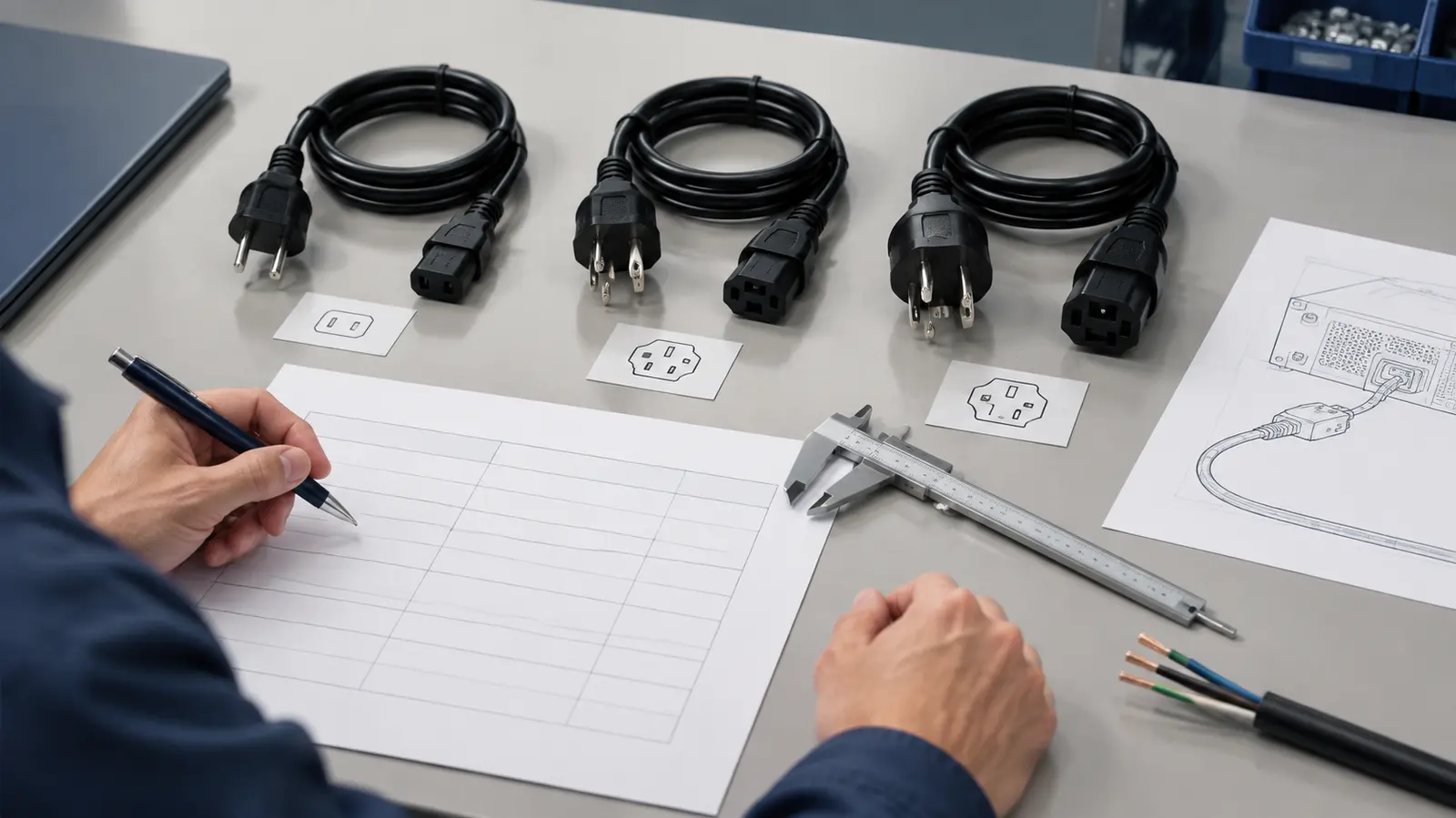
Consider a hypothetical inquiry with one line: “Please quote a Brazil 10A or 20A power cord.” It names a market and a current value, but it does not identify the finished assembly that should be quoted. A difference in the wall-side format, equipment connection, device requirements, cable construction, or project documents can make a visually similar sample unusable or stop the project at its next review.
The practical response is not to ask a supplier to guess between 10A and 20A. Turn the request into inputs that can be checked. The following list is for procurement and engineering communication; it does not replace the current rules of the destination market, certification-body requirements, or project-level engineering judgment.
Start at the wall: two-pin or three-prong
“Brazil plug” is not a quote-ready interface description. State whether the wall-side plug is two-pin or three-prong, then attach clear front and back photographs, a dimensional drawing, an existing part number, or details of a physical sample. Include grounding, cable exit direction, colour, mould appearance, and packaging where they affect the project.
HSC’s current catalogue can be a useful starting point: it lists a Brazil Two Pin 10A Power Cord, a Brazil Three Prong 10A Power Cord, and a Brazil Three Prong 20A Power Cord. They are three separate catalogue records, not interchangeable finished assemblies simply because their names are similar.
For 10A or 20A, return to the device and the complete assembly
A 10A or 20A label can narrow the conversation, but it cannot determine the final configuration by itself. Provide the equipment nameplate data, intended conditions of use, system or project requirements, and the known plug and equipment-side interface. That gives the supplier and project owner one complete assembly against which to identify what needs further review.
Do not treat “the equipment looks low-power” as enough evidence for a power-cord project. The cable, plug, equipment connection, termination method, and documentation need to be reviewed as one package. If any item is still open, label it as “to be confirmed” in the RFQ rather than assuming that a previous project’s conclusion applies.
Do not leave the equipment end undefined
The other end of a power cord also decides whether it can be assembled and used. It may be a standard connector, a custom termination, bare wire, or terminals. Provide front and back photographs, key dimensions, pin information, or the mating equipment model. Also say whether an existing sample is only an appearance reference, an interface reference, or an approved production basis.
The correct wall-side plug does not make the whole cord usable. If the equipment end is unspecified, a supplier can offer only a conditional quote. Adding it later can change the cable length, termination, tooling, or packaging plan.
Make the cable description traceable to a drawing or sample
“A black 1.5 m power cord” leaves out many inputs that affect quotation and installation. At a minimum, state the length reference, core count, conductor or cable requirement, jacket requirement, outside-diameter limit, colour, exit direction at both ends, and conditions such as repeated flexing, movement, moisture, oil, heat, or a limited installation space.
When the inputs are not complete, sample and drawing control become especially important. Tell the supplier which drawing revision is current, what may be proposed, and which dimensions or materials cannot change. An old sample is not automatically the full technical requirement: it may represent only appearance, or a different project revision.
Ask documents: “for which assembly?”
Each of the three Brazil product records named above lists ASTA, SASO, COC, SIRIM, INMETRO, and SII in the current catalogue. Those fields describe their respective catalogue records. They do not automatically extend to an unconfirmed combination of plug, cable, equipment connection, and rating.
A more useful question is: which documents must this project review, and which finished construction does each one address? If the interface, length, material, or termination changes, what must the responsible project party confirm again? Raising those questions before sampling is usually more manageable than tracing documents late in the delivery schedule.
Close the gaps with one RFQ checklist
A quote-ready Brazil power-cord RFQ can include at least these items:
- Wall-side plug: two-pin or three-prong format, photograph or drawing, colour, and cable exit direction.
- Equipment and project: nameplate data, intended use, and known project constraints.
- 10A or 20A: an assembly condition to be checked alongside device and interface information.
- Equipment end: connector, terminals, bare wire, or custom termination with photographs, dimensions, pin information, or part number.
- Cable: length reference, core count, cable or jacket requirements, diameter limits, and use environment.
- Finished-product controls: current drawing revision, sample status, labels, packaging, and delivery quantity.
- Documents: the documents to review, their applicable finished assembly, and the responsible party for confirming their scope.
This checklist does not replace technical review. It does give procurement, engineering, and the supplier the same set of facts to work from. In an early-stage project, clearly marking an unknown can be more useful than presenting an assumption as a requirement.
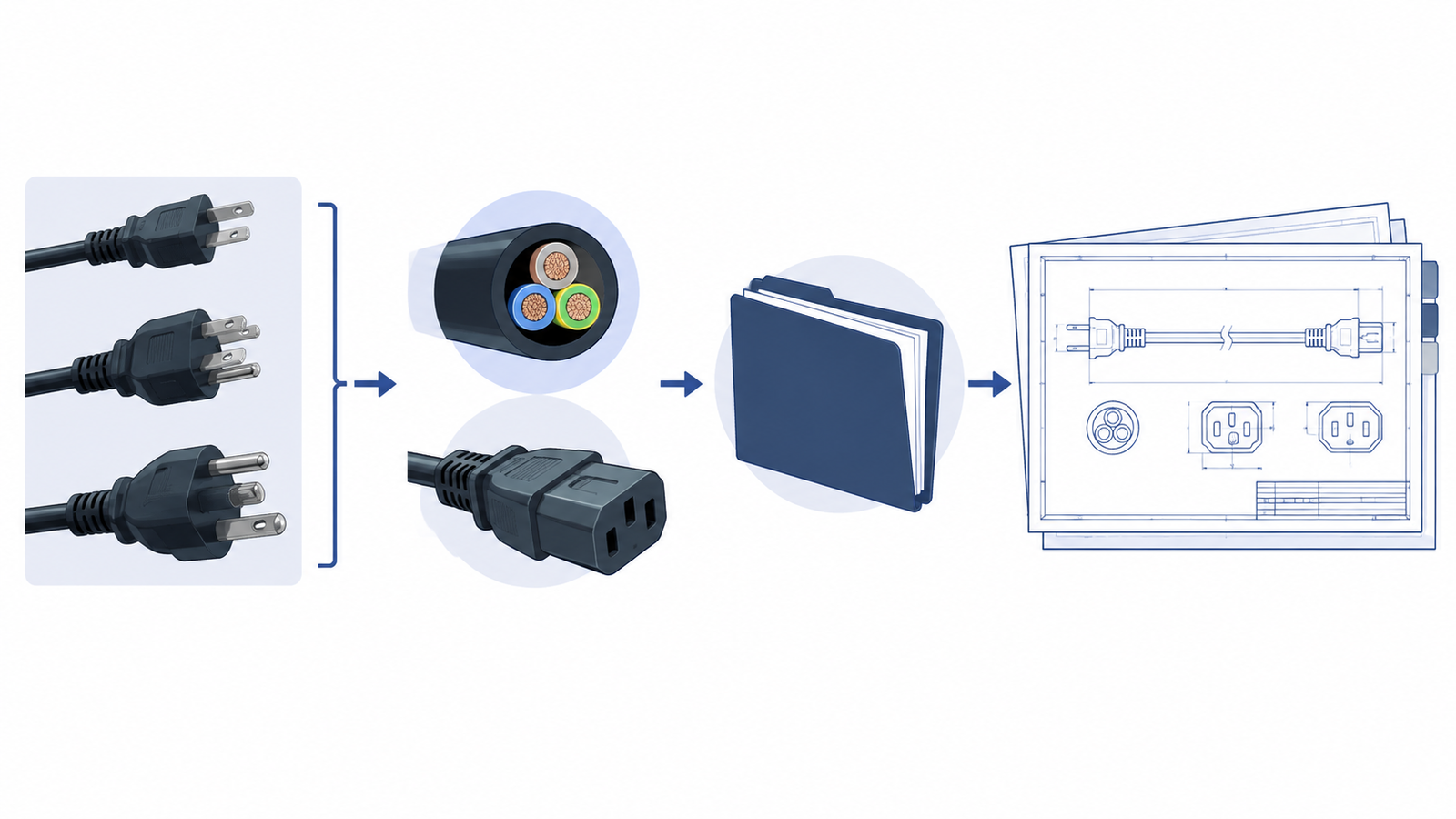
To organize an inquiry from available product directions, start with the Power Cords and Plugs category and add the real project conditions to the RFQ.
This article provides general industry information. Specific technical requirements remain subject to the current standards and certification-body rules of the target market.
RELATED EVIDENCE